Introduction
The aim in writing this book is to pass a lifetime of bonsai experience on to anyone who enjoys bonsai and wishes to make use of it. There is information here that has been gained over many years from a range of sources and if you want to make use of it to improve your collection of bonsai, please do so by any means you like. Just please accept it as our contribution to the world of bonsai that has provided us with so much pleasure over the years.
Malcolm and I were initially introduced to bonsai in 1977; probably, like so many others, it was a complete accident. A lifetime interest in all things oriental found me browsing a newly opened Japanese shop in the Birmingham Bull Ring Palisades one Friday afternoon and there, on the inside of the door was a small and fairly insignificant poster advertising the second ever Midland Bonsai Society Show, to be held at the Church Hall in Shirley, South Birmingham. It was planned for the following day, Saturday, so why not have a look?
Malcolm and I were initially introduced to bonsai in 1977; probably, like so many others, it was a complete accident. A lifetime interest in all things oriental found me browsing a newly opened Japanese shop in the Birmingham Bull Ring Palisades one Friday afternoon and there, on the inside of the door was a small and fairly insignificant poster advertising the second ever Midland Bonsai Society Show, to be held at the Church Hall in Shirley, South Birmingham. It was planned for the following day, Saturday, so why not have a look?
The Midland Bonsai Society had only been in existence for some two or three years and, on reflection, a number of the trees displayed were rather immature, but Malcolm and I were hooked! We found them delightful and signed up for membership on the spot. We never looked back; it seemed just months before were asked to become committee members and because of the Chairman’s ill health, I found myself unexpectedly in the role of Chairman two years later.
The Midland had the good fortune to be in at the forefront of British bonsai during a period when it was rapidly becoming a popular hobby. The Society had at one time some 150 members and it soon became part of the newly established Federation of British Bonsai Societies (FoBBS.). At that time, there were just three major bonsai traders in the U.K. – Price & Adams located in Surrey (namely Peter Adams) and Greenwood Gardens in the Midlands (Harry Tomlinson). The third was Bromage & Young, again in Surrey; they kept a low profile as presenters but were probably the first main importers of bonsai from Japan.
Peter Adams, author of several highly successful books on bonsai, was a person of inspiration in British bonsai, having a vast horticultural knowledge, had royal Academy of Arts training as well as having teaching experience. He was at that time the “British master” and a teacher and mentor to all those other notable names we hold in great respect to this day – Dan Barton, Harry Tomlinson, Craig Coussins, Bill Jordan, Colin Lewis and others were all influenced by Peter’s knowledge and guidance. We were fortunate to know him well from these early years and, when he later remarried and moved to the U.S.A., we were in a position to acquire part of his amazing bonsai collection.

These bonsai personalities were an inspiration to us and many others; we were able to take ourselves and the society to new heights. In 1987, a recently established Federation of British Bonsai Societies was in a position to offer to host a European Bonsai Association Convention – a first in terms of International bonsai events in the U.K. Conventions and National exhibitions had now become an established part of the British bonsai scene. This had resulted from a small group of enthusiasts from the Midlands area who made a massive effort to mount the first ever British Bonsai Convention at Keele University in 1981; these were to become annual events with hundreds of enthusiast attending.
Ultimately, this led to Peter Brown, the then Chairman of FoBBS, offering to host an International event in the U.K. on behalf of Bonsai Clubs International, a leading North American organisation with claims to be a world organisation. FoBBS’s offer was accepted and the task of organising the event was given to the then Chairman, Graham Gavin. Tragically, before the process could be more than a dream, Graham died suddenly, resulting in Malcolm becoming Chairman. He himself was already involved full time as a university lecturer as well as conducting research, so had little time to spare. I on the other hand, was teaching and in an administrative role in a large comprehensive school at a time when the Local Authority was offering early retirement to the top paid teachers; I took advantage of the offer and retired, allowing myself two years to learn new skills, namely organising conventions and using computers.
The result was the International Bonsai Convention of 1991, one of the first held outside Japan. We hired the entire International Convention Centre in central Birmingham which, in 1989 was only just about to be built. As it was officially to be opened by Her Majesty, the Queen, in June 1991, we took a chance of it being completed on time – it was the Queen after all – and thankfully, it was ………… just!
Thus, in July 1991, we launched this three-day event to an audience of nearly 800 full weekend delegates and 5,000+ exhibition visitors. The delegates came from twenty-three countries around the world and including the President of the newly formed World Bonsai Friendship Federation, Saburo Kato; a further twenty-nine Japanese attended. Twenty-four U.K. bonsai societies put on displays around a central National Bonsai Exhibition, with a further sixty-three traders from the U.K. and Europe. Some sixteen demonstrators, including Peter Adams, Dan Barton, Chase Rosade, John Naka Hideo Kato, and Hotsumi Terakawa participated throughout that weekend.
During those same years, we started taking coach parties of British enthusiasts across the Channel to European bonsai events and bonsai nurseries. At that time, some European countries were ahead of us in terms of bonsai development and nurseries such as Bonsai Centrum in Heidelberg and Lodders nursery in Vleuten, Holland, proved an amazing experience to these British enthusiasts. Few, if any, had seen so many trees of quality and in such numbers that a nursery such as Lodders had imported from Japan; several acres of greenhouses with hundreds of trees covering a range of species and buildings full of bonsai pots, tools and other accessories. Purchases made, monies exchanged and an overloaded coach full of happy but financially poorer enthusiasts heading back across the Channel to the U.K.
All this was the start of our future in bonsai; we continued to organise bonsai tours to Europe and then to other parts of the world which included taking groups to Japan on four occasions. The first such trip also took in the first World Bonsai Convention in 1989, held at Saitama, near Tokyo. Other overseas trips took in Australia, the U.S.A. including Hawaii, Taiwan, and on a number of occasions, China. We made friends at every level of bonsai, visiting and staying with bonsai masters, nurserymen and local society members, being welcomed into their homes and their business premises, seeing their bonsai, and being allowed to photograph their private collections.
In 1984, Malcolm was asked to be part of the Federation of British Bonsai Societies board, later becoming its Chairman. He was also to become President of the European Bonsai Association as well as being a consultant to the World Bonsai Friendship Federation. This has resulted in our attending dozens of bonsai conventions and exhibitions around the world, on almost all occasions, with our cameras.
This means that we acquired a vast wealth of knowledge and experience that we would like to share with you all. We feel very strongly that knowledge is a very precious thing, something that it is not for sale but is there for the use of everyone wanting to benefit from it. Likewise we have strong feelings about people who state that knowledge is something for sale, only available to those paying to acquire it.
We are all here because we have bonsai and want to share all we have learned over the years whilst doing bonsai. Life can be short; we are not going to have all that much longer so we would like our legacy to be a lifetime of experienced shared.
I would wish to express our appreciation to those people from whom we have learned or gleaned knowledge over the years - some from workshops and demonstrations but most frequently, from little gems of information dropped casually in conversation; it is amazing how much accumulates over a lifetime.
Peter Adams
For a wealth of horticultural as well as artistic know-how.
Dan Barton
For his humour and artistic eye, his keenness to experiment with techniques together with knowledge of bonsai pots and pottery – “he always had just the right pot for your tree”.
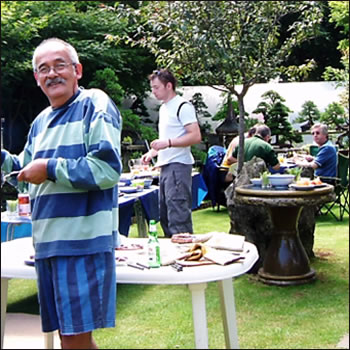
Peter Brown
Two for the price of one – Malcolm Hughes & Peter Brown, both former Chairmen of F.o.B.B.S., Presidents of E.B.A. and Directors of W.B.F.F..
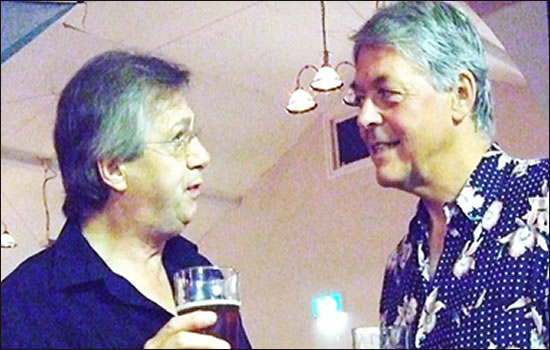
The Crespi family
Who come from Parabiago, north-west of Milan, Italy, - a family business like no other in Europe. The father, Luigi, awarded the Japanese “Order of the Rising Sun” for his contribution to bonsai, owns and works at the nursery although well into his 80’s; together with his wife, son, daughter and grandson, they organise regular bonsai events within the nursery that can often surpass some international exhibitions and conventions. They bring in trees from around the world together with major bonsai masters and provide a level of hospitality that only Italy can offer. It was at one of their events in 2012 that we met Takeo Kawabe, their principle demonstrator and teacher who proved more than willing to share his knowledge and experience to all present.
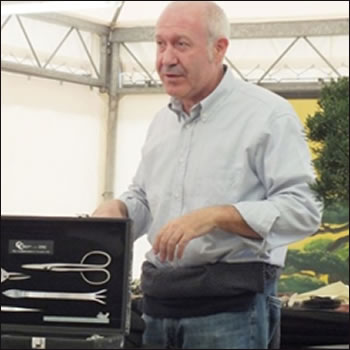
Bill Jordan
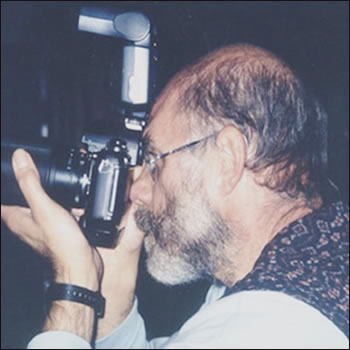
Horst Krekeler
Who inspired us with the thought of the peace and tranquillity brought about through working on small trees and showing us that working with bonsai was itself a source of therapy.
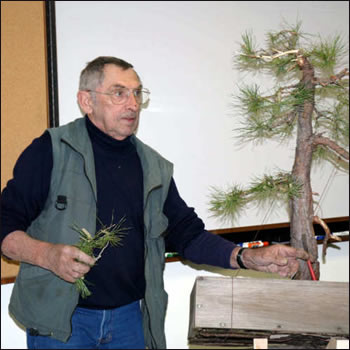
Paul Lesniewicz
Who showed us that bonsai also meant friendship and generosity and whose nursery in Heidelburg was a centre of exquisite bonsai, hospitality and good humour.
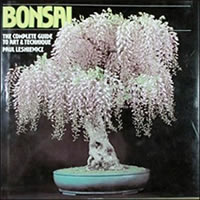
Paul Lesniewicz’ popular book on bonsai – one of the earliest published in English.

Colin Lewis
Who introduced us to the concept of shohin bonsai as opposed to small and immature trees. He was also one of the first to introduce us to really fine wiring, right to the tips of even the finest bits of twiggery.
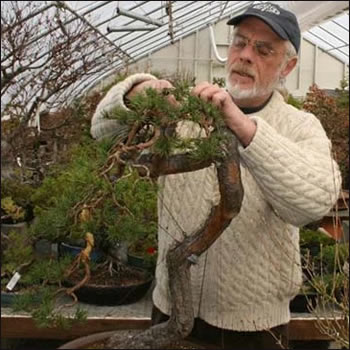
Jim McCurrach
Thank you for a wealth of collected larches from discarded plants in parts of forestry plantations.
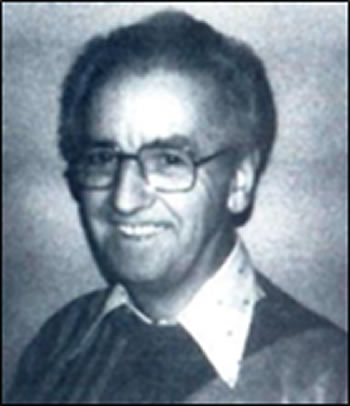
Marc Noelanders
Who taught us, through their demonstrations and workshops both at our home and at conventions, that so much could be learned by sitting and watching trees being transformed into works of art, with every branch and small twig placed with such love and care. Add to that their gems of horticultural as well as design inspiration.
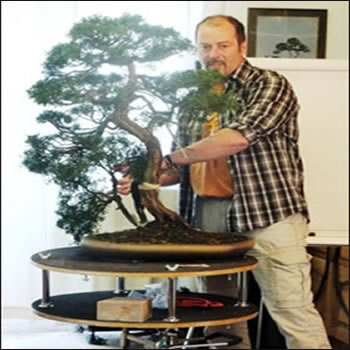
Salvatore Liporace
The authors with Salvatore Liporace, at the Asia-Pacific Bonsai Convention, Taiwan, 2009.
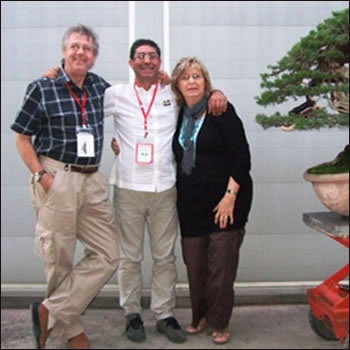
Dan Robinson
From Seattle, U.S.A. – now that is a man not well known on this side of the Atlantic but someone with a wealth of knowledge and experience unique in itself. He was a firefighter based a Bremerton Navy Yard and who served with the U.S. Army in Korea. During his period in Korea, he collected vast numbers of black pine seed and, on returning to the United States, planted them in his garden. He now has a collection of black pine, grown from seed and semi-trained, in the region of 40 to 50 years old – an absolutely amazing collection. Whilst staying with him, we learned what can be done in a relatively small area of garden given time, patience and work over many years. If ever you are in the Seattle area of the north-west U.S.A., do make a point of visiting Elandan Gardens, Dan’s bonsai centre on the shores of Sinclair Inlet off Puget Sound where you will see rock and driftwood that you never knew existed outside of dreams.
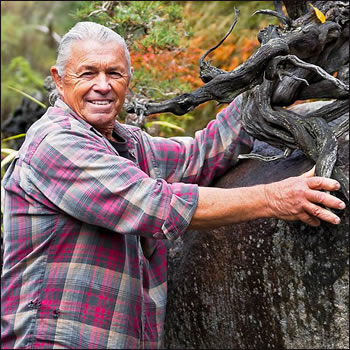
Chase Rosade
Who came from New Hope, U.S.A. He first demonstrated at the FoBBS Convention in Brighton, Sussex in 1989, and returned to this country several times since. We became firm friends, staying at each other’s homes many times and enjoying bonsai experiences with Chase and his wife Solita. Many of these experiences we shared at various conventions around the world at places we never dreamed we would ever have visited, but for bonsai..
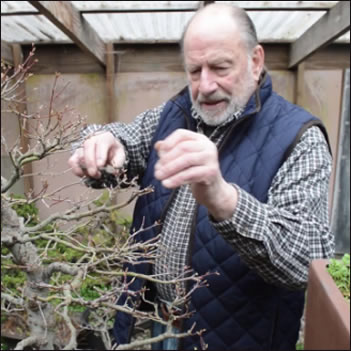
Hotsumi Terakawa
Who we first met in 1987 when he did his first U.K. demonstration at the E.B.A. Convention that we helped organise at the N.E.C. near Birmingham. He was very young and extremely talented, having completed his apprenticeship with bonsai master Hideo Kato for seven years before moving to Lodders Bonsai Nursery in the Netherlands. We have met up with Hotsumi over many years since then and learned much from him, in particular the significance of space within the bonsai tree being as almost of equal importance as the placement of branches.
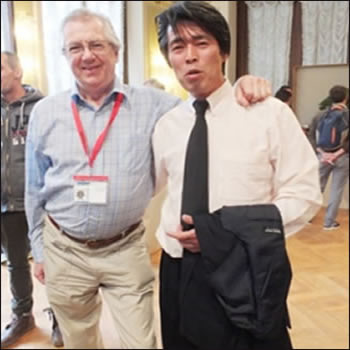
Steve Tolley
To whom we owe thanks for helping us acquire some specimen material and in particular for teaching us so much about the care and development of collected material. He, together with Francoise Jeker from France, taught us that yamadori bonsai are not for those wanting instant gratification; rather that you must love the tree and let it tell you when it is ready for the next stage in its development as a bonsai..

Francoise Jeker
Francoise, a great respecter of trees, gives thanks to the tree he has worked on at the end of every demonstration. He always demonstrates on material collected years before being worked on and they always survive. In turn, Steve is justifiably critical of those demonstrating on recently collected trees (less than a year or two after being collected), demonstrators who go on to take the tree to “completion”, even to the extent of repotting at the same demo – sometimes going further to sell or auction that same tree to some innocent members of their audience.
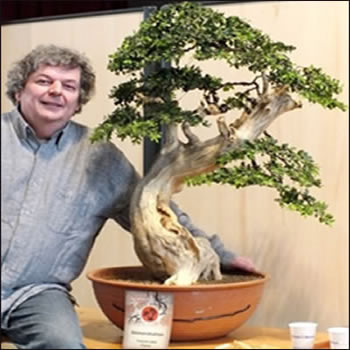
Harry Tomlinson
Who was one of the first to show what could be done in creating groups of even immature trees.
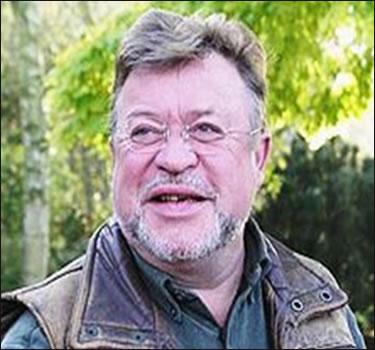
Kevin Willson
Never did we ever dream in those early days that deadwood and carving could be an art form in itself.
More Friends
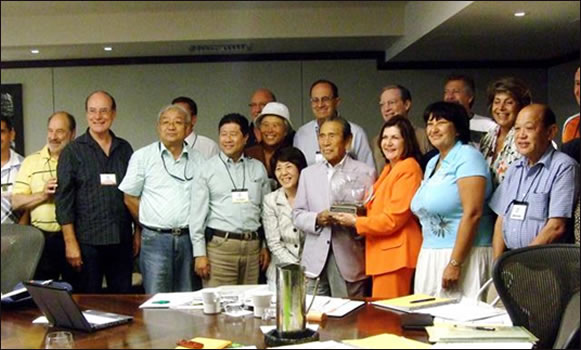
WBFF Board at Puerto Rica Bonsai Congress
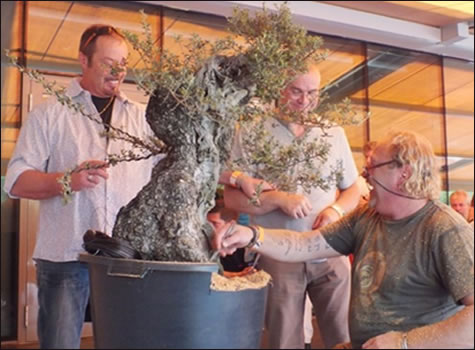
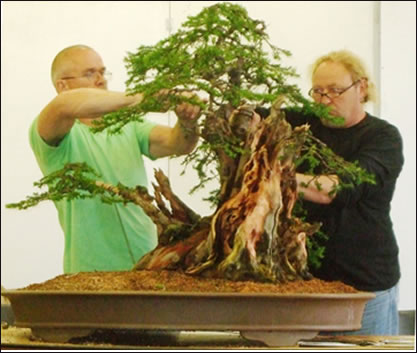
Marc Noelanders (left) & Kevin Willson (seated), EBA Congress, Ljubljana, 2012.
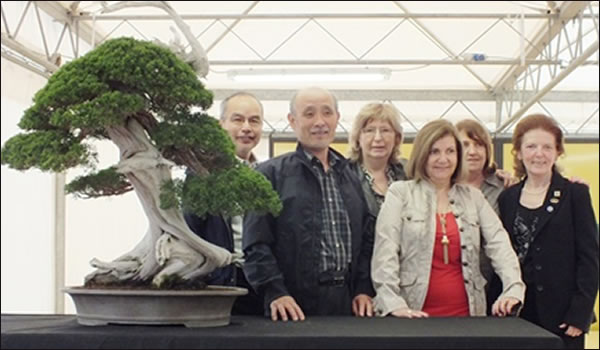
Takeo Kawabe (2nd from left), Kath Hughes, Solita Rosade, President of WBFF, Glenis Bebb, President BCI and Gudrun BenzPresident European Suiseki Association (ESA)
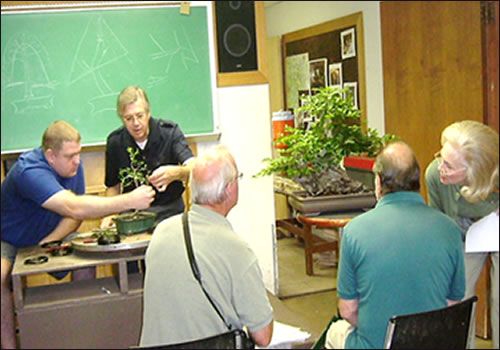
Malcolm running workshop in the Bonsai studio of Chase & Solita Rosade
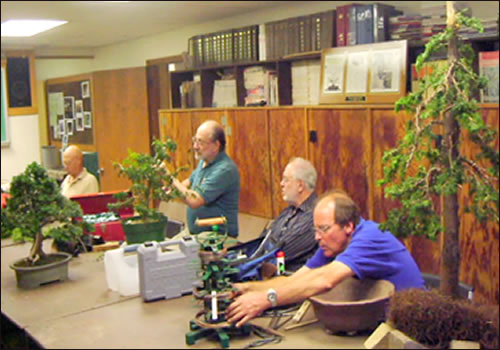
Chase Rosade (standing) with workshop group.
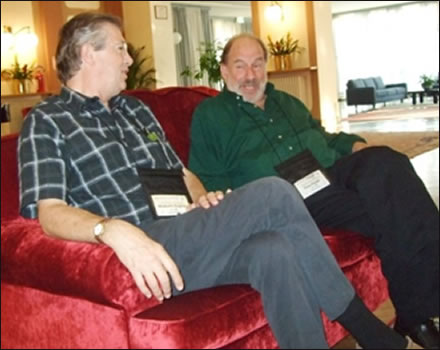
Malcolm Hughes with Chase Rosade, BCI Convention, Aosta, Italy, 2008.
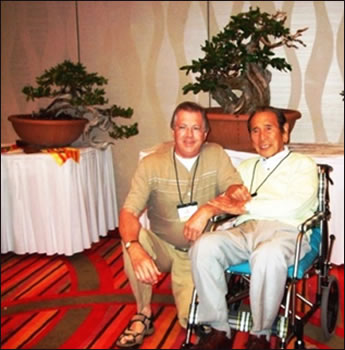
Malcolm with Daizo Iwasaki (Vice-Chairman, WBFF) at the Puerto Rica Convention, 2009
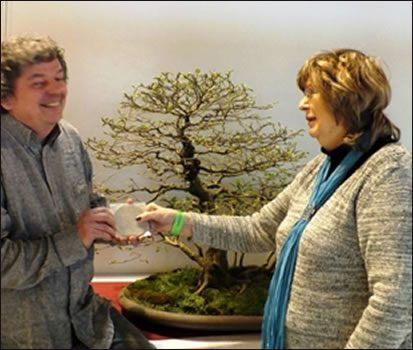
Francoise receiving BCI Award from Kath, Audincourt, 2013.

A small part of Lodders Bonsai Nursery, Vleuten, Netherlands
Final Thoughts
For more detailed species-based information of a generic nature, we looked to the encyclopaedic resources of the Royal Horticultural Society and Wikipedia. For trade-specific information regarding the range of items available to purchase for use with bonsai, our source of information has been Kaizen Bonsai for which we thank Graham Potter for his permission. When we have used more extensive information we have made reference in the text to the articles and sources used.
Photographs are our own drawn from many exhibition, conventions and private collections we have visited, never photographed without the owner or organisers permission.
Sketches of all kinds are drawn by Malcolm although he gives thanks to others for providing the inspiration for many of them, in particular Peter Adams, Dan Barton, Paul Lesniewicz and John Naka.
For further information more specific than what we offer, we suggest the vast amount of information out there in books and on websites.
Books we have learned a lot from and recommend to you include authors such as Peter Adams who books cover varying levels from beginners to advanced styling, Dan Barton for aesthetics, advanced styling and a serious approach to specific skills and techniques. These are again well covered by Francoise Jeker and in the two volumes of John Naka’s books whilst Saburo Kato addresses all there is to learn about group plantings.
Adams, P., (1985): “Bonsai Designs – Scots Pine, Common Juniper, Japanese Larch”. Publ. Peter Adams.
Adams, P., (1985): “Bonsai Designs – Japanese Maples”. Publ. Peter Adams.
Adams, P., (1990): “Bonsai Design –Deciduous and Coniferous Trees”. Ward Lock Ltd.
Adams, P., (1999): “Bonsai Landscapes”. Ward Lock Ltd.
Barton, D., (1989): “The Bonsai Book”. Ebury Press.
Jeker, F., (2006): “Bonsai Aesthetics- A Practical Guide”.
Kato, S., (1988): “Forest, Rock Plantings & Ezo Spruce Bonsai”. National Bonsai Foundation, N.Y.
Naka, J. (1984 and 1998): “Bonsai Techniques Vols. I and II”. Bonsai Institute of California.
For photographic inspiration in terms of styles and design, a number of books illustrating some superb images of bonsai are available. These include Chinese and Japanese books with impressive coloured images of bonsai exhibited at various exhibitions over many years, e.g. the International Bonsai & Suiseki Exhibition as well as European events, most notably those of the “Noelanders’ Trophy” events. Marc Noelanders’ books, published over the last twenty years, illustrate every tree exhibited at this annual event and have been an inspirational source of ideas.
Peter Adams once told us that, at night, he would often look at images of bonsai, often from Japanese exhibitions, and commit them to memory. Thus, when confronted with a new untrained tree to work on and create as a bonsai, he would draw on his memory of those images until he found the one most appropriate to this material.
Websites
There exist many websites and they are growing in number all the time. Do bear in mind however, that they do not have to answer to anyone for accuracy of facts or prejudice of ideas. Use these websites – they can be invaluable, but do not venture into them blindly. Remember that, as with any subject matter, just because someone has chosen to state something, do not assume it is necessarily correct. Always be a little sceptical and prepared to double check. Ideally, seek out those websites belonging to a person acknowledged as an authority in bonsai.
Think carefully if using international websites where they advise specific months for doing work on bonsai. Remember that the months given do not necessarily corresponded to those of your country – think in “seasons” and not “months”.
Websites are very useful for obtaining equipment and trees but not all give out information freely; what information provided may be basic. Those sites providing more in-depth information can require paid membership, so use them selectively.
Such has been our life in bonsai accompanied by wonderful experiences over many years and some of the remarkable personalities with whom we have shared them.
Kath Hughes
October 2020
Web design: nysys

